Side-quest
About this project
Blackjack is a game of complete information, unlike poker where the information is incomplete and you do not know your opponent's cards. That availability means there is a correct play in every spot, the one with mathematically the best financial outcome. It does not matter that you "always bust when you hit on 15", or that you are "never lucky when you double down". The maths is the maths. Worth adding that the best outcome does not always mean winning the most. Sometimes it means losing the least, where every option loses money but some lose less than others.
Step one: basic strategy
Becoming a winning blackjack player starts with mastering what is called Basic Strategy, the table that answers how you should play every starting hand against every dealer up card. That sounds daunting put like that, but a lot of it is common sense and large chunks follow the same rule. Nearly all the hard totals, for instance, can be expressed as "stand 12+ v 6 or lower, hit 12-16 v 7+, hit 8 or lower, double 10 and 11 v anything, double 9 v 6 or lower". For most people a week is all it takes to memorise the chart, though it shifts a little depending on the table rules around splitting and doubling. Pro tip: if you ever want a quick read on how good someone is at blackjack, ask them how they play soft 18. It is the most complicated number to remember.
Turning the edge around
Now that you can play perfectly you are still in a game where the house holds somewhere between 0.6% and 1.1%, depending on the rules. To turn that around you need three things:
- How to count the cards
- How Basic Strategy changes given the count
- How much to bet when the cards are in your favour
Counting
Counting is a simple matter of starting at zero, adding one when a 2 to 7 appears and subtracting one when a Ten or an Ace appears. That is the Running Count, and it is the first number you need. Next you estimate, or count, how many cards have been played in total, and use that to work out the Decks Remaining. Divide the Running Count by the Decks Remaining and you have the True Count. If the RC is +10 and there are 4 decks remaining, the TC is 10 / 4 = 2.5. That conversion matters: an RC of 20 with 7 decks remaining is good but unremarkable, whereas an RC of 20 with 2 decks remaining is probably the best shoe of blackjack you will ever see.
Deviations
Knowing the True Count is only useful if you know what to do with it, which is play slightly differently and bet more. At a TC of 1 the game is roughly 50/50, pleasant enough but not yet worth raising your bets. What it does change is how you play a couple of very marginal spots. 16 v 10 switches from a hit to a stand, which actually happens at any positive count, and by TC 2 so does 12 v 3. Learning these deviations, along with the count itself, is what turns blackjack from a game of chance into a game of skill.
Bet sizing
The last piece is knowing how far to push your bets as the True Count climbs. You might be betting £5 as a base, £10 at TC 2, £25 at TC 3, £75 at TC 4 and so on. The reason is that your chance of winning rises with the count. At TC 3 you are roughly a 3% favourite over the house, so that is when the bigger bets need to be out.
The shift in odds is small, so knowing how to count is not the same as winning all the time. That would be the dream. What it means is that you can play when the maths is in your favour and, over a large enough sample, make some money.
What the tool does
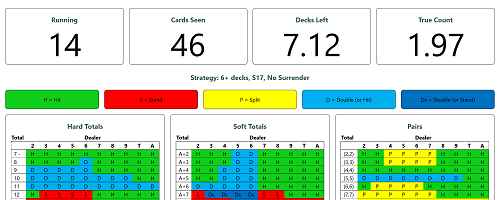
It lets you set up the conditions of the tables you actually play at, enter the cards you have seen as High, Low or Neutral, and track the running count, the decks remaining and the true count. Below that it shows the Basic Strategy chart for your game, and as the True Count moves it applies the required deviations to that chart. You can use it to practise your counting and to play a better informed game.